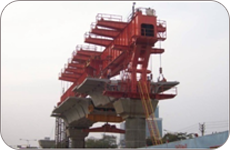

Hydraulic jacks are used to maintain the level of Launching gantry.Once launching gantry is successfully installed, segments shall be delivered to site via multi-axle trailer.Segment shall be lifted one at each time via our hydraulic jacks and attach to launching gantry via lifting bars and bring to position the slider beam. Next segment shall be connected to the previous segment by bar and jack system to ensure the perfect fit. Epoxy glue shall be used at the joint of the two segments. Similar process shall be carried out until all segments for the particular span have been erected, connected and glued. Launching gantry shall support the whole of segments for the entire span prior to next operation.
Once all tendons have been stressed, span (connected segments) shall be lowered down from launching gantry to the pier caps. Load of span from the launching gantry shall be transferred to the pier caps. Once the launching gantry is free, auto launching may proceed. Auto launching is the process of bringing the launching gantry to the next span (next pier caps). Launching gantry travels forward on top of the completed span to the next span. All longitudinal movements & cross traverse movements of the launcher are controlled by hydraulic jacks.
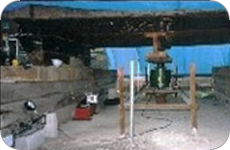
The jacks are used to position the segments in exactly the right final position. After lifting the load the lock nut is so adjusted that it rests firmly on the top of the cylinder and the whole load is taken up by the cylinder, thus eliminating any possibility of its coming down in case of accidental failure of the mechanism. This also enables the holding up the load for long duration without straining the hydraulic system and ensures the safety of workers working underneath supported heavy structures like, heavy beams, launching girders of bridges, supported structures in tunnels etc.
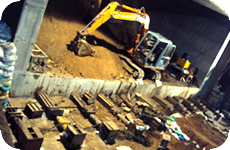
The purpose of pushing of Box is to form a horizontal opening below ground or through embankments, can say a tunnel, by providing precast box units underground or an embankment, without disturbing the overhead amenities, like traffic & structures. To reduce the frictional resistance, a thin film of Grease and thick gauge plastic sheet is provided between the top of the thrust bed & Bottom of the Box. This is done before casting of the Bottom slab of the box. A Glossy Epoxy layer is also provided to reduce friction on the top and prevent the disturbance of the mass over box to least during progress of pushing Where mass of embankment is less or the soil is of poor quality, drag sheet system is also considered for least resistance of friction and disturbance of mass above box.
With the progress of jacking, the front unit with shield penetrates into the embankment and there after excavation within the shield is done either manually or mechanically and the excavated stuff is transported outside the working area.After the first segment advances to the end of the thrust bed, the second segment is brought in alignment of the front Box & intermediate jacking space is lift between the two. The progress of pushing is kept continuous and the system of side shifting of remaining box segments from Auxiliary bed and bring in pushing alignment is adopted till total length is pushed.
The entire Box Pushing system is matter of proper selection of Hydraulic equipments, as tremendous driving force is required for pushing of medium to large size of Boxes. So for this, Number of Jack units are provided in series for distribution of pushing load evenly on the face of the concrete, and all Jacks are operated simultaneously with a common power pack, which supplies uniform flow of pressure through network of Hydraulic pipes of required pressure capacity, commencing from front unit to rear unit. Jacking force is applied in sequence. This way pushing cycles are repeated till total pushing is completed.
Designed by Softons Web Design Solutions